Oppenheimer
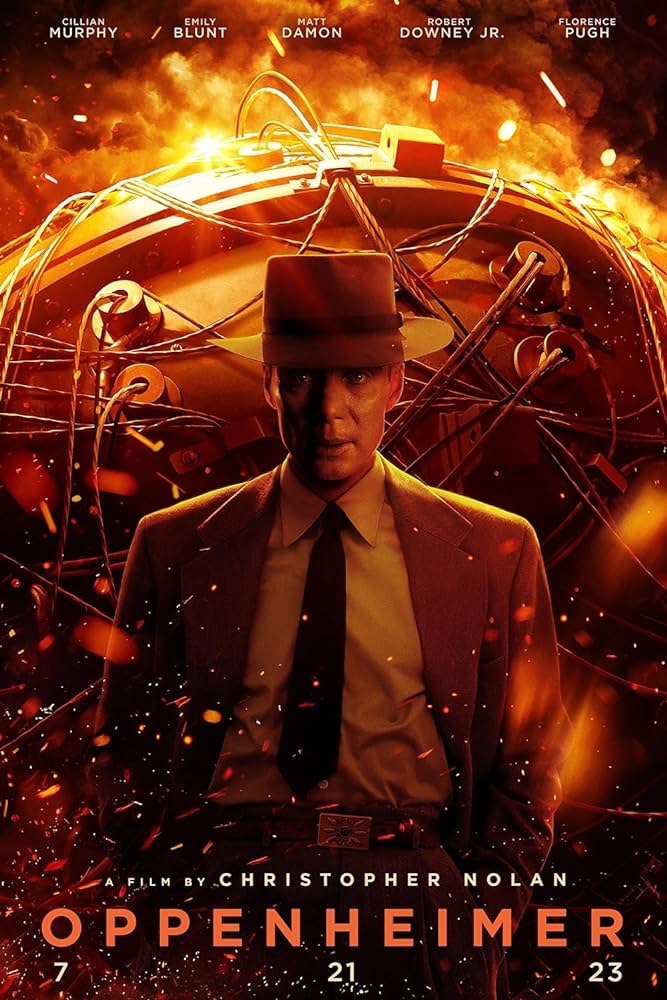
Director: Christopher Nolan.
Screenplay: Christopher Nolan.
Starring: Cillian Murphy, Robert Downey Jr, Matt Damon, Emily Blunt, Florence Pugh, Josh Hartnett, Casey Affleck, Rami Malek, Gary Oldman, Alden Ehrenreich, Jason Clarke, Kenneth Branagh, Tom Conti, Matthew Modine, Dane DeHaan, Benny Safdie, Olivia Thirlby, David Krumholtz, Tony Goldwyn, Macon Blair, James D’Arcy, Scott Grimes, Matthias Schweighofer, Alex Wolff, Michael Angarano, David Dastmalchian, Josh Peck, Jack Quaid, Gustaf Skarsgard, James Urbaniak, Christopher Denham, James Remar.
“Now I am become Death, the destroyer of worlds”
When Christopher Nolan releases a new film, it goes without saying that his new endeavours create mass excitement among film enthusiasts. I certainly show an interest myself. However, there’s a saying that you’re only as good as your last movie and on that note, I hold a potentially contentious opinion on his recent output in that his last two films in Dunkirk and Tenet were quite underwhelming. That said, I reckon he’s getting back on track with this fearless historical epic that explores similar themes that were the crux for his sci-fi masterwork Interstellar.

Plot: During the Manhattan Project, theoretical physicist J. Robert Oppenheimer (Cillian Murphy) is the director of the Los Alamos Laboratory and responsible for the research and design of the atomic bomb. It’s not until his work has the full impact, however, that he’s left to reflect on his achievements and responsibilities while facing interrogation about supposed communist links that threaten to end his career.

When considering the scope and ambition of Nolan’s biopic on J. Robert Oppenheimer, it’d be wise to pay attention to the quote at the very opening of the film: “Prometheus stole fire from the gods and gave it man. For this he was chained to a rock and tortured for eternity.” Directly following this we cut to leading man Cillian Murphy’s observant eyes on ripples of water where Nolan uses this as a paradoxical visual motif for the individual in question with the cause and effect image juxtaposed with the forthcoming bomb blasts that would ripple throughout the earth. From the offset, it’s a clever image that states the intentions of Nolan to delve into the mindset of what he personally describes as “the most important man to ever have lived”.
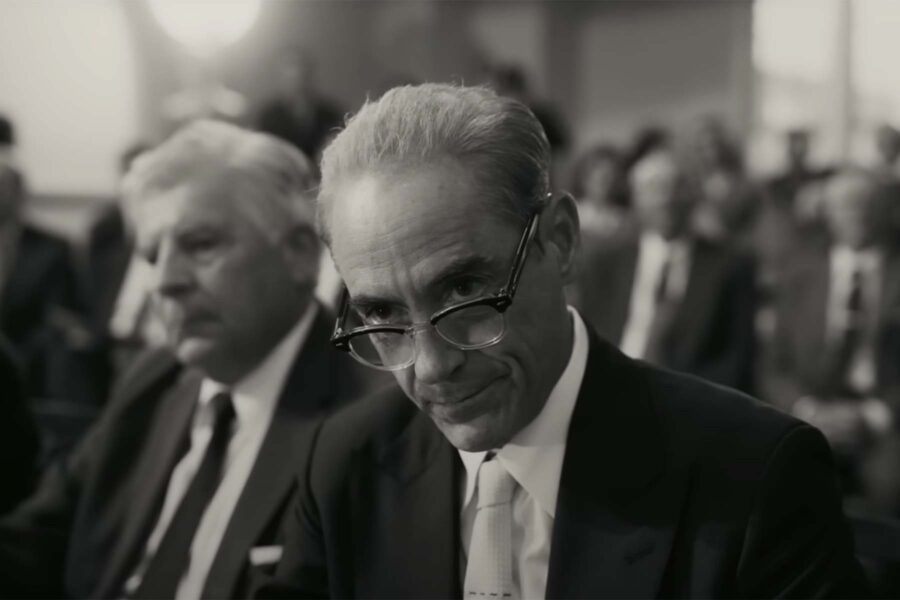
The first hour is primarily concerned with exploring Oppenheimer’s teaching of quantum mechanics alongside his romantic relationships with Florence Pugh’s Psychiatrist Jean Tatlock and Emily Blunt as his long-suffering, alcoholic wife Kitty. These are interspersed with some political leanings towards Communism during the Spanish civil war and flashbacks to senate hearings featuring Robert Downey Jr’s U.S. Atomic Energy Commissioner Lewis Strauss and his involvement in revoking Oppenheimer’s security clearance which would essentially end his life’s work. The Downey/Strauss scenes are an essential part of the story that Nolan wants to tell (based on the book American Prometheus by Kai Bird and Martin J. Sherwin) but it’s the romantic timeline that doesn’t add anything to the overall depiction of Oppenheimer. In fact, the most exciting young actress around at present, Florence Pugh, is particularly wasted and seemingly only hired to shed her clothes in a couple of unnecessary sex scenes while Blunt has one grandstanding moment (later in the film) from a very two-dimensionally written role. In other words, it’s a very male-centric story where the female characters are not depicted with as much importance as I’m sure they would’ve had in reality.

It’s not until the arrival of Matt Damon’s Lieutenant General Leslie Groves that the pace begins to crank up and The Manhattan Project gets under full swing with the Hydrogen Bomb becoming a very real possibility (and problem) for humanity. The sheer scale of this moment in history is frightening and Nolan manages to capture it in all its impactful capacity. There’s a genuine danger in never being able to turn back as at one point Oppenheimer enlists the advice of Albert Einstein (Tom Conti) after the mathematical theory suggests that even by testing this bomb could ignite the atmosphere and eradicate our entire civilisation. While the atomic test scene is impressively handled (miraculously without the use CGI) alongside a thunderous score by Ludwig Göransson this is still not what the film is building towards. As important as this moment in history was, it’s somewhat less about the bomb itself and more about the aftermath where Nolan invites us to ponder the moral quandary behind it all.

With this invention and its eventual use by the U.S. Army on the cities of Hiroshima and Nagasaki (which led to the surrender of the Japanese and an end to World War II) there is a magnitude to what Oppenheimer has facilitated and, to this day, may yet still lead to the end of mankind’s existence. This is not lost on Nolan’s depiction of the man either, though. Nor is it from Murphy’s tortured performance. Despite the huge array of characters and the host of familiar faces that embody them, this is Murphy’s film. It’s entirely resting on his shoulders and it’s an impressive conjuring of the complexity and conflict that Oppenheimer faced. At one point there’s a speech that reflects his realisation whereby the sound is muted and it really can’t capture the impact of one man’s moral turmoil any better; the revelation and reminder of such an act and the rippling after effects that a man of such intelligence is more than aware of.

Verdict: When all is said and done, Nolan is a filmmaker that invites the audience to engage and discuss and he does so again here. There’s lots of strands and facets that he expertly juggles and despite its dialogue heavy, 3 hour running time, it’s never dull or anything less than engaging. It also isn’t as narratively complex as you might expect. For a film dealing with such weighty themes Nolan delivers it impressively on layman’s terms and while I don’t subscribe to this being the “masterpiece” that some critics would have you believe, it’s still draws you into the experience and it’s cumulative effect is one of the most thrilling biopics you’re likely to find.

Mark Walker
Trivia: Oliver Stone said of this film, “I sat through 3 hours of ‘Oppenheimer,’ gripped by Chris Nolan’s narrative. His screenplay is layered and fascinating. I once turned the project down because I couldn’t find my way to its essence. Nolan has found it.” Oppenheimer has been compared to Stone’s JFK (1991), another 3-hour political epic with an ensemble cast. Nolan has in fact said he screened JFK for the crew before production for inspiration of the kind of movie he had in mind.
 MARKED MOVIES
November 27, 2023 at 9:21 pm
I don’t think we could agree more. Oppenheimer is an undeniably well and thoughtfully made epic but the praise really got out of control with this one. “Film of the Century” is where I have to draw the line — there’s an emotional coldness to this film that makes it feel more removed as an emotional spectacle than it ought to be. I certainly liked but didn’t love it. (We’re also in agreement on Tenet, though I did love Dunkirk)
LikeLike
November 27, 2023 at 10:15 pm
We’re certainly not camping our tents too far at all, man. This definitely isn’t the film of the century or a masterpiece but it’s a damn fine film nonetheless. I won’t say I disliked Dunkirk (I gave it 3.5) but it didn’t hit the heights of The Thin Red Line or Saving Private Ryan for me when I kinda expected that. Tenet was a disaster though: I mean what the fuck was going there? Maybe I need to rewatch it?
LikeLike
November 30, 2023 at 7:14 pm
I want to watch this one, I’ll just have to get myself into the mood for a 3 hour drama.
LikeLiked by 1 person
December 2, 2023 at 10:34 am
It’s very good and to be fair, the 3 hours fly by. It’s very well paced.
LikeLiked by 1 person