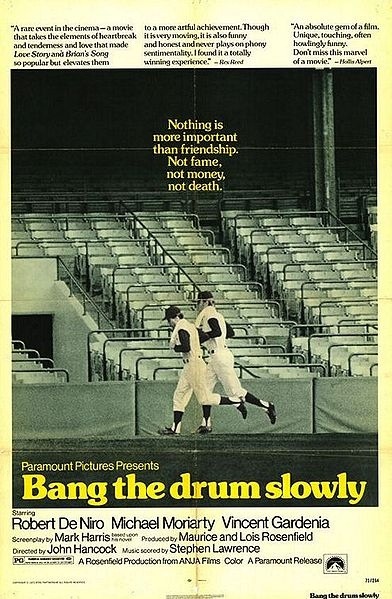
Director: John Hancock.
Screenplay: Mark Harris.
Starring: Michael Moriarty, Robert DeNiro, Vincent Gardenia, Phil Foster, Ann Wedgeworth, Patrick McVey, Heather MacRae, Selma Diamond, Barbara Babcock, Tom Ligon, Danny Aiello.
In 1973, two films were released that featured two very different performances from a young Robert DeNiro. One was his first collaboration with director Martin Scorsese in “Mean Streets” and the other was “Bang The Drum Slowly“. However, despite the critical plaudits DeNiro received for the former, it’s was arguably this film that caught everyone’s eye beforehand. Either way, they both marked the arrival of, what would be, one of cinema’s finest performers.
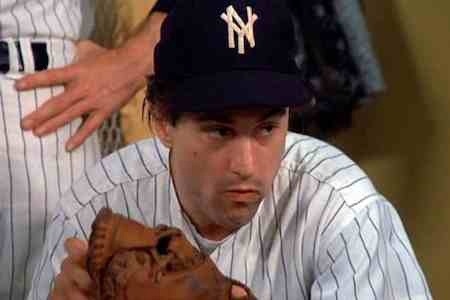
Henry Wiggen (Michael Moriarty) is the star pitcher of a New York professional Baseball team. He’s the type of player that can name his price when it comes to contractual negotiations. On hearing the news that his friend (and surplus-to-requirements) teammate Bruce Pearson (Robert DeNiro) is terminally ill, Henry negotiates a contract that will keep Bruce in team and save him from being transferred. Henry’s intention is to give Bruce a memorable last season at the club.
On first appearances, this film comes off as a cheap TV movie with a music score that isn’t far from something as cheesy as “Little House on the Prairie“. Quite simply, the music is dreadful but the performances manage to transcend it’s dated approach. It’s interesting watching a young DeNiro before the heights of stardom and it’s easy to see that he always had the acting ability. There’s an innocence and lack of self-confidence to his character and he plays it wonderfully. This, however, adds to another problem in the film; his talents are not utilised as well as they could be. It’s Moriarty that takes the lead and although he also delivers a solid performance, he comes across a little expressionless at times. Despite both actors playing well, the close relationship between their characters is never explained and leaves it hard to fully connect with them or accept the events that take place. That being said, the film does still have a heart and a lightness of touch which help it overcome it’s faults. It’s not a story about a dying man but more a story about life and living it fully. It’s a story about integrity and the camaraderie and teamwork amongst men. It’s also somewhat of a sports film but that becomes secondary to the human relationships. With material of this nature, the film could easily fall prey to cliche but it manages to avoid the pitfalls which is thanks to it’s sensitivity and assured handling by director John Hancock. It’s an enjoyable film but left me feeling a little frustrated at DeNiro being so underused. I know he wasn’t a star at this time but when he’s as good as he is here, you just want to see more. What it does do though, is show that he’s always had a magnetic screen presence.
A touching and poignant drama that also manages to be an understated sports film. Not many films manage to achieve this balance and despite some flaws and it’s now dated appearance, this is still worthy of attention: if only, to witness the early stages of a very illustrious career.
Mark Walker
































 MARKED MOVIES